Senin, 07 Maret 2022

Online Education


Online education is a flexible instructional delivery system that encompasses any kind of learning that takes place via the Internet. Online learning gives educators an opportunity to reach students who may not be able to enroll in a traditional classroom course and supports students who need to work on their own schedule and at their own pace. 

The quantity of distance learning and online degrees in most disciplines is large and increasing rapidly. Schools and institutions that offer online learning are also increasing in number. Students pursuing degrees via the online approach must be selective to ensure that their coursework is done through a respected and credentialed institution.

The quantity of distance learning and online degrees in most disciplines is large and increasing rapidly. Schools and institutions that offer online learning are also increasing in number. Students pursuing degrees via the online approach must be selective to ensure that their coursework is done through a respected and credentialed institution.With the increased availability of the Internet and computer technology, students are able to access information anytime and anyplace that would normally be available only through a traditional classroom. Studies have shown that students learn just as effectively in an online classroom as they do in the traditional classroom.

POSITIVE AND NEGATIVE EFFECTS OF LEARNING ONLINE

Online education offers many positive benefits since studens : have flexibility in taking classes and working at their own pace and time face no commuting or parking hassles learn to become responsible for their own education with information available at their fingertips find the submission of assignments easy and convenient are more apt to voice their own opinions and share and debate issues with other students, as well as learn from other students during the group discussions

Possible negative effects of learning online are that some students: may miss the face-to-face interaction with the instructor and among student may prefer to attend traditional classes with an instructor who teaches and guides them through the course find access to the necessary technology challenging and the availability of technical support limited . In addition, some administrators and instructors who do not understand the workload may display a negative attitude toward online education.

FUTURE OF ONLINE EDUCATION

Online teaching is here to stay. Many students prefer the online classroom since it offers flexibility in their busy schedules. With the proliferation of information and knowledge, students must become lifelong learners in today's world, and online education plays an important role in helping individuals access learner-centered and self-directed instruction.

With enhanced software, hardware, and Internet access, more options for online education will become available. With student enrollments increasing faster than classrooms can be built, students becoming more proficient with technology, and students pursuing an education that meets their needs, the future of online education will continue to grow. Online degree programs will become more widely accepted as they become a more common practice.

Please watch video what meaning is online education : 


www.encyclopedia.com/finance/finance-and-accounting-magazines/online-education

Jogging


Jogging is a form of trotting or running at a slow or leisurely pace. The main intention is to increase physical fitness with less stress on the body than from faster running but more than walking, or to maintain a steady speed for longer periods of time. Performed over long distances, it is a form of aerobic endurance training.

Definition

Jogging is running at a gentle pace; its definition, as compared with running, is not standard. In general, jogging speed is between 4 to 6 miles per hour (6.4 to 9.7 km/h) Running is sometimes defined as

Exercise

Jogging may also be used as a warm up or cool down for runners, preceding or following a workout or race. It is often used by serious runners as a means of active recovery during interval training. For example, a runner who completes a fast 400 meter repetition at a sub-5-minute mile pace (3 minute km) may drop to an 8-minute mile jogging pace (5 minute km) for a recovery lap.

Jogging can be used as a method to increase endurance or to provide a means of cardiovascular exercise but with less stress on joints or demand on the circulatory system.

Benefits

According to a study by Stanford University School of Medicine, jogging is effective in increasing human lifespan, and decreasing the effects of aging,with benefits for the cardiovascular system. Jogging is useful for fighting obesity and staying healthy.Säpojoggen jogging event in Sweden

The National Cancer Institute has performed studies that suggest jogging and other types of aerobic exercise can reduce the risk of lung, colon, breast and prostate cancers, among others.It is suggested by the American Cancer Society that jogging for at least 30 minutes five days a week can help in cancer prevention.

While jogging on a treadmill will provide health benefits such as cancer prevention, and aid in weight loss, a study published in BMC Public Health reports that jogging outdoors can have the additional benefits of increased energy and concentration. Jogging outdoors is a better way to improve energy levels and advance mood than using a treadmill at the gym.

Jogging also prevents muscle and bone damage that often occurs with age, improves heart performance and blood circulation and assists in preserving a balanced weight gain.

A Danish study released in 2015 reported that "light" and "moderate" jogging were associated with reduced mortality compared to both non-jogging and "strenuous" jogging. The optimal amount per week was 1 to 2.4 hours, the optimal frequency was less than or equal to 3 times per week and the optimal speed was "slow" or "average". A recent meta-analysis on running/jogging and mortality, including more than 230,000 participants found that runners were at 27% lower risk of death than non-runners, during 5.5-35 year follow-ups.


Jogging - Wikipedia

Basketball


 Basketball is a team sport in which two teams, most commonly of five players each, opposing one another on a rectangular court, compete with the primary objective of shooting a basketball (approximately 9.4 inches (24 cm) in diameter) through the defender's hoop (a basket 18 inches (46 cm) in diameter mounted 10 feet (3.048 m) high to a backboard at each end of the court), while preventing the opposing team from shooting through their own hoop. A field goal is worth two points, unless made from behind the three-point line, when it is worth three. After a foul, timed play stops and the player fouled or designated to shoot a technical foul is given one, two or three one-point free throws. The team with the most points at the end of the game wins, but if regulation play expires with the score tied, an additional period of play (overtime) is mandated.

Players advance the ball by bouncing it while walking or running (dribbling) or by passing it to a teammate, both of which require considerable skill. On offense, players may use a variety of shots – the layup, the jump shot, or a dunk; on defense, they may steal the ball from a dribbler, intercept passes, or block shots; either offense or defense may collect a rebound, that is, a missed shot that bounces from rim or backboard. It is a violation to lift or drag one's pivot foot without dribbling the ball, to carry it, or to hold the ball with both hands then resume dribbling.

The five players on each side fall into five playing positions. The tallest player is usually the center, the second-tallest and strongest is the power forward, a slightly shorter but more agile player is the small forward, and the shortest players or the best ball handlers are the shooting guard and the point guard, who implements the coach's game plan by managing the execution of offensive and defensive plays (player positioning). Informally, players may play three-on-three, two-on-two, and one-on-one.

Invented in 1891 by Canadian-American gym teacher James Naismith in Springfield, Massachusetts, United States, basketball has evolved to become one of the world's most popular and widely viewed sports.The National Basketball Association (NBA) is the most significant professional basketball league in the world in terms of popularity, salaries, talent, and level of competition. Outside North America, the top clubs from national leagues qualify to continental championships such as the EuroLeague and the Basketball Champions League Americas. The FIBA Basketball World Cup and Men's Olympic Basketball Tournament are the major international events of the sport and attract top national teams from around the world. Each continent hosts regional competitions for national teams, like EuroBasket and FIBA AmeriCup.

The FIBA Women's Basketball World Cup and Women's Olympic Basketball Tournament feature top national teams from continental championships. The main North American league is the WNBA (NCAA Women's Division I Basketball Championship is also popular), whereas the strongest European clubs participate in the EuroLeague Women.


Basketball - Wikipedia

Photography


Photography is the art, application, and practice of creating durable images by recording light, either electronically by means of an image sensor, or chemically by means of a light-sensitive material such as photographic film. It is employed in many fields of science, manufacturing (e.g., photolithography), and business, as well as its more direct uses for art, film and video production, recreational purposes, hobby, and mass communication.

Typically, a lens is used to focus the light reflected or emitted from objects into a real image on the light-sensitive surface inside a camera during a timed exposure. With an electronic image sensor, this produces an electrical charge at each pixel, which is electronically processed and stored in a digital image file for subsequent display or processing. The result with photographic emulsion is an invisible latent image, which is later chemically "developed" into a visible image, either negative or positive, depending on the purpose of the photographic material and the method of processing. A negative image on film is traditionally used to photographically create a positive image on a paper base, known as a print, either by using an enlarger or by contact printing.


Photography - Wikipedia

Seafood


Seafood is any form of sea life regarded as food by humans, prominently including fish and shellfish. Shellfish include various species of molluscs (e.g. bivalve molluscs such as clams, oysters and mussels, and cephalopods such as octopus and squid), crustaceans (e.g. shrimp, crabs, and lobster), and echinoderms (e.g. sea cucumbers and sea urchins). Historically, marine mammals such as cetaceans (whales and dolphins) as well as seals have been eaten as food, though that happens to a lesser extent in modern times. Edible sea plants such as some seaweeds and microalgae are widely eaten as sea vegetables around the world, especially in Asia. In the United States, although not generally in the United Kingdom, the term "seafood" is extended to fresh water organisms eaten by humans, so all edible aquatic life may be referred to as "seafood".

Seafood is an important source of (animal) protein in many diets around the world, especially in coastal areas. Semi-vegetarians who consume seafood as the only source of meat are said to adhere to pescetarianism.

The harvesting of wild seafood is usually known as fishing or hunting, while the cultivation and farming of seafood is known as aquaculture and fish farming (in the case of fish). Most of the seafood harvest is consumed by humans, but a significant proportion is used as fish food to farm other fish or rear farm animals. Some seafoods (i.e. kelp) are used as food for other plants (a fertilizer). In these ways, seafoods are used to produce further food for human consumption. Also, products such as fish oil and spirulina tablets are extracted from seafoods. Some seafood is fed to aquarium fish, or used to feed domestic pets such as cats. A small proportion is used in medicine, or is used industrially for nonfood purposes (e.g. leather).


Seafood - Wikipedia

Traditional Indonesia Food


Indonesian cuisine is a collection of various regional culinary traditions that formed the archipelagic nation of Indonesia. There are a wide variety of recipes and cuisines in part because Indonesia is composed of approximately 6,000 populated islands of the total 17,508 in the world's largest archipelago, with more than 1,300 ethnic groups. Many regional cuisines exist, often based upon indigenous culture with some foreign influences. Indonesia has around 5,350 traditional recipes, with 30 of them considered the most important. Indonesia's cuisine may include rice, noodle and soup dishes in modest local eateries to street-side snacks and top-dollar plates.

Indonesian cuisine varies greatly by region and has many different influences. Sumatran cuisine, for example, often has Middle Eastern and Indian influences, featuring curried meat and vegetables such as gulai and curry, while Javanese cuisine is mostly indigenous, with some hint of Chinese influence. The cuisines of Eastern Indonesia are similar to Polynesian and Melanesian cuisine. Elements of Chinese cuisine can be seen in Indonesian cuisine: foods such as noodles, meat balls, and spring rolls have been completely assimilated.

Throughout its history, Indonesia has been involved in trade due to its location and natural resources. Additionally, Indonesia's indigenous techniques and ingredients were influenced by India, the Middle East, China, and finally Europe. Spanish and Portuguese traders brought New World produce even before the Dutch came to colonise most of the archipelago. The Indonesian islands the Moluccas (Maluku), which are famed as "the Spice Islands", also contributed to the introduction of native spices, such as cloves and nutmeg, to Indonesian and global cuisine.

Indonesian cuisine often demonstrates complex flavour,acquired from certain ingredients and bumbu spices mixture. Indonesian dishes have rich flavours; most often described as savory, hot and spicy, and also combination of basic tastes such as sweet, salty, sour and bitter. Most Indonesians favour hot and spicy food, thus sambal, Indonesian hot and spicy chili sauce with various optional ingredients, notably shrimp paste, shallots, and others, is a staple condiment at all Indonesian tables. Seven main Indonesian cooking methods are frying, grilling, roasting, dry roasting, sautéing, boiling and steaming.

Opor ayam (curry style), gulai, ketupat, diced potatoes with spices, and bawang goreng served during Lebaran (Eid al-Fitr) in Indonesia
Some popular Indonesian dishes such as nasi goreng, gado-gado, satay, and soto are ubiquitous in the country and are considered national dishes. The official national dish of Indonesia however, is tumpeng, chosen in 2014 by Indonesian Ministry of Tourism and Creative Economy as the dish that binds the diversity of Indonesia's various culinary traditions.[4] However, later in 2018, the same ministry has chosen 5 national dish of Indonesia; they are soto, rendang, satay, nasi goreng, and gado-gado.

Indonesia is the home of sate; one of the country's national dishes, there are many variants across Indonesia.
Today, some popular dishes that originated in Indonesia are now common to neighbouring countries, Malaysia and Singapore. Indonesian dishes such as satay, beef rendang, and sambal are favoured in Malaysia and Singapore. Soy-based dishes, such as variations of tofu and tempeh, are also very popular. Tempeh is regarded as a Javanese invention, a local adaptation of soy-based food fermentation and production. Another fermented food is oncom, similar in some ways to tempeh but using a variety of bases (not only soy), created by different fungi, and particularly popular in West Java.

Fast Food


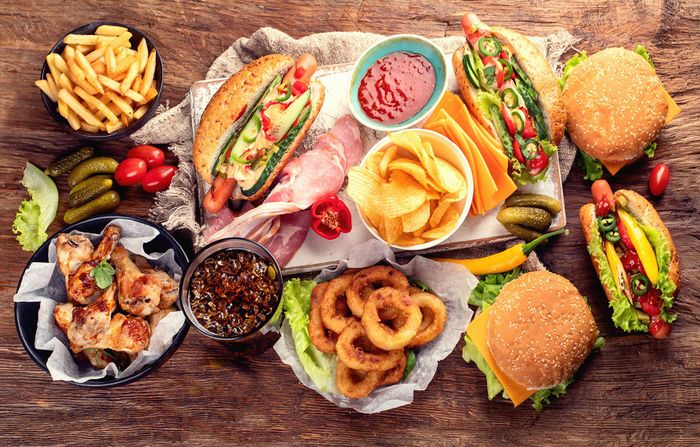
Fast food is a type of mass-produced food designed for commercial resale and with a strong priority placed on "speed of service" versus other relevant factors involved in culinary science. Fast food was created as a commercial strategy to accommodate the larger numbers of busy commuters, travelers and wage workers who often did not have the time to sit down at a public house or diner and wait for their meal. By making the speed of service the priority, this ensured that customers with strictly limited time (a commuter stopping to procure dinner to bring home to their family, for example, or an hourly laborer on a short lunch break) were not inconvenienced by waiting for their food to be cooked on-the-spot (as is expected from a traditional "sit down" restaurant). In 2018, the fast food industry was worth an estimated $570 billion globally.

The fastest form of "fast food" consists of pre-cooked meals kept in readiness for a customer's arrival (Boston Market rotisserie chicken, Little Caesars pizza, etc.), with waiting time reduced to mere seconds. Other fast food outlets, primarily the hamburger outlets (McDonald's, Burger King, etc.) use mass-produced pre-prepared ingredients (bagged buns and condiments, frozen beef patties, vegetables which are prewashed, pre-sliced, or both; etc.) but the hamburgers and french fries are always cooked fresh (or at least relatively recently) and assembled "to order" (like at a diner).

Although a wide variety of food can be "cooked fast", "fast food" is a commercial term-limited to food sold in a restaurant or store with frozen, preheated, or precooked ingredients and served to the customer in a packaged form for take-out/take-away.

Fast food restaurants are traditionally distinguished by their ability to serve food via a drive-through. Outlets may be stands or kiosks, which may provide no shelter or seating,  or fast food restaurants (also known as quick service restaurants). Franchise operations that are part of restaurant chains have standardized foodstuffs shipped to each restaurant from central locations.

Fast food began with the first fish and chip shops in Britain in the 1860s.[citation needed] Drive-through restaurants were first popularized in the 1950s in the United States. The term "fast food" was recognized in a dictionary by Merriam–Webster in 1951.

Eating fast food has been linked to, among other things, cardiovascular disease, colorectal cancer, obesity, high cholesterol, insulin resistance conditions and depression.Controlling for other diet and lifestyle confounders of fast food consumers often doesn't attenuate these associations and it sometimes strengthens the association between fast food consumption and mortality. Many fast foods tend to be high in saturated fat, sugar, salt and calories.

The traditional family dinner is increasingly being replaced by the consumption of takeaway fast food. As a result, the time invested on food preparation is getting lower, with an average woman in the United States spending 47 minutes per day preparing food and the average man spending 19 minutes per day in 2013.


Fast food - Wikipedia

Home

  Hello This is Wildatul Aluf  Blog hope you enjoy it......   I Learn Internet Blogging in STIBA-IEC Jakarta  Blogging is my new hobby now h...