Hello This is Wildatul Aluf Blog hope you enjoy it......
I Learn Internet Blogging in STIBA-IEC Jakarta
Blogging is my new hobby now hope you like it
 |  |
 |
 |
 |
GOOGLE BUSINESS | YOUTUBE |

Hello This is Wildatul Aluf Blog hope you enjoy it......
I Learn Internet Blogging in STIBA-IEC Jakarta
Blogging is my new hobby now hope you like it
| |
|
|
|
GOOGLE BUSINESS | YOUTUBE |

Apa saja pelayanan yang disediakan di STIBA-IEC LC ini? Berikut beberapa yang siap kami layani yang di antaranya adalah:
Semua pelayanan di atas dapat dilakukan baik secara daring (online) ataupun luring (off-line).

Dengan berbasis eCampus yang dilengkapi dengan Information Communication Technology (ICT), program ini memberikan akses yang mudah dan fleksibel bagi mahasiswa dengan sistem pembelajaran yang efektif, praktis dan efisien.
Keunggulan SDL diantaranya: praktis dan fleksibel, hemat waktu dan biaya, materi mudah didokumentasikan, dan memiliki sistem pembelajaran yang ramah dan mudah dijalankan.
Keunggulan ini yang menjadikan SDL pilihan yang tepat bagi mahasiswa yang ingin kuliah sambil bekerja maupun bagi orang-orang yang sudah bekerja namun belum menempuh pendidikan tinggi.

Calon mahasiswa STIBA-IEC Jakarta adalah lulusan SMA/SMK/MA dari semua jurusan
Mengisi dan menyerahkan formulir pendaftaran dengan melampirkan:
PEMBUKAAN DAN TES MASUK
Tes dilaksanakan pada hari sabtu

VISI
“Menjadi sekolah tinggi yang berkualitas dan unggul di bidang bahasa dan sastra asing pada tahun 2030 di wilayah DKI Jakarta yang berstandar nasional dan mampu berperan aktif dalam pembangunan bangsa melalui proses pendidikan, penelitian dan pengabdian masyarakat.”
MISI
TUJUAN
1. Menghasilkan lulusan tingkat sarjana bahasa dan sastra asing (Bahasa dan Sastra Inggris) yang bermoral dan berkompeten dalam bidangnya dan memiliki daya analisis, berfikir sistematis dan logis, berwawasan luas, berdedikasi terhadap ilmu pengetahuan dan teknologi, memiliki integritas kepribadian, serta menjunjung tinggi nilai-nilai kemanusiaan.
2. Mengembangkan ilmu pengetahuan di bidang bahasa dan sastra asing (Bahasa dan Sastra Inggris) melalui kegiatan penelitian.
3. Mengimplementasikan keahlian dan pengetahuan di bidang bahasa dan sastra asing (Bahasa dan Sastra Inggris) kepada masyarakat.
4. Menjalin kemitraan dalam upaya pemberdayaan dan peningkatan sumber daya manusia.
5. Menyiapkan lulusan yang dapat menerapkan keahliannya dalam bidang bahasa dan sastra asing (Bahasa dan Sastra Inggris) serta dapat memenuhi kebutuhan masyarakat
Alamat: Jl. Raya Jatinegara Barat No.187, RT.3/RW.3, Bali Mester, Kecamatan Jatinegara, Kota Jakarta Timur, Daerah Khusus Ibukota Jakarta 13310

Since blended learning is highly context-dependent, a universal conception of it is difficult. Some reports have claimed that a lack of consensus on a hard definition of blended learning has led to difficulties in research on its effectiveness. A well-cited 2013 study broadly defined blended learning as a mixture of online and in-person delivery where the online portion effectively replaces some of the face-to-face contact time rather than supplementing it. Additionally, a 2015 meta-analysis that historically looked back at a comprehensive review of evidence-based research studies around blended learning, found commonalities in defining that blended learning was "considered a combination of traditional f2f [face to face] modes of instruction with online modes of learning, drawing on technology-mediated instruction, where all participants in the learning process are separated by distance some of the time." This report also found that all of these evidence-based studies concluded that student achievement was higher in blended learning experiences when compared to either fully online or fully face-to-face learning experiences. "Blended learning" is sometimes used in the same breath as "personalized learning" and differentiated instruction.
Terminology
The terms "blended learning", "hybrid learning", "technology-mediated instruction", "web-enhanced instruction", and "mixed-mode instruction" are often used interchangeably in research literature.
Although the concepts behind blended learning first developed in the 1960s, the formal terminology to describe it did not take its current form until the late 1990s. One of the earliest uses of the term appears in a 1999 press release, in which the Interactive Learning Centers, an Atlanta-based education business, announced a change of name to EPIC Learning. The release mentions that "The Company currently operates 220 on-line courses, but will begin offering its Internet courseware using the company's Blended Learning methodology.
The term "blended learning" was initially vague, encompassing a wide variety of technologies and pedagogical methods in varying combinations (some making no use of technology whatsoever). In 2006, the term became more concrete with the publication of the first Handbook of Blended Learning by Bonk and Graham. Graham challenged the breadth and ambiguity of the term's definition, and defined "blended learning systems" as learning systems that "combine face-to-face instruction with computer-mediated instruction". In a report titled "Defining Blended Learning", researcher Norm Friesen suggests that, in its current form, blended learning "designates the range of possibilities presented by combining Internet and digital media with established classroom forms that require the physical co‐presence of teacher and students".
Advantages
Blended instruction is reportedly more effective than purely face-to-face or purely online classes.[30] Blended learning methods can also result in high levels of student achievement more effective than face-to-face learning
By using a combination of digital instruction and one-on-one face time, students can work on their own with new concepts which frees teachers up to circulate and support individual students who may need individualized attention. "Rather than playing to the lowest common denominator – as they would in a traditional classroom – teachers can now streamline their instruction to help all students reach their full potential."
Proponents of blended learning argue that incorporating the "asynchronous Internet communication technology" into higher education courses serves to "facilitate a simultaneous independent and collaborative learning experience".
This incorporation is a major contributor to student satisfaction and success in such courses. The use of information and communication technologies have been found to improve student attitudes towards learning.
By incorporating information technology into class projects, communication between lecturers and part-time students has improved, and students were able to better evaluate their understanding of course material via the use of "computer-based qualitative and quantitative assessment modules".
Blended learning also has the potential to reduce educational expenses, although some dispute that blended learning is inherently less expensive than traditional classroom learning.
Blended learning can lower costs by putting classrooms in the online space and it essentially replaces pricey textbooks with electronic devices that students often bring themselves to class. E-textbooks, which can be accessed digitally, may also help to drive down textbook budgets. Proponents of blended learning cite the opportunity for data collection and customization of instruction and assessment as two major benefits of this approach.
Blended learning often includes software that automatically collects student data and measures academic progress, providing teachers, students and parents detailed students data. Often, tests are automatically scored, providing instantaneous feedback. Student logins and work times are also measured to ensure accountability.Schools with blended learning programs may also choose to reallocate resources to boost student achievement outcomes.
Students with special talents or interests outside of the available curricula use educational technology to advance their skills or exceed grade restrictions.Blended learning allows for personalized education, replacing the model where a teacher stands in front of the classroom and everyone is expected to stay at the same pace. "Blended learning allows students to work at their own pace, making sure they fully understand new concepts before moving on."
A classroom environment that incorporates blended learning naturally requires learners to demonstrate more autonomy, self-regulation, and independence in order to succeed. If teachers offer a form of initial program orientation before introducing blended learning strategies, it can better prepare students to feel confident navigating the different components and developing a stronger sense of independence.
Some online institutions connect students with instructors via web conference technology to form a digital classroom. These institutions borrow many of the technologies that have popularized online courses at the university level. Some advantages of blended learning, particularly at a Kindergarten to grade 12 level of education, can be found under the general concept of educational technology. It is also one of the most effective ways for personalized learning at scale.
Blended learning supports the use of standards as a way to manage quality and ease of use. This includes multiple kinds of standards: interoperability standards like the SIF specification from A4L or the Learning Tools Interoperability specification from IMS Global Consortium or academic standards like state standards and Common Core State Standards, which encourage integration of technology into a variety of subjects.
A learning management system, or federation of systems, helps develop a better feel for an online community where discussions can be held to better aid students. This virtual learning environment helps connect professors with students without physically being present, thus making this a 'virtual cafe'. Many schools use this online tool for online classes, classwork, question & answer forums, and other school related work.
Blended learning yielded positive results from the online community. Such results were compared and showed similar results from that of Alcoholics Anonymous and Weight Watchers. The advantages of blended learning are dependent on the quality of the programs being implemented. Some indicators of excellent blended learning programs are "facilitating student learning, communicating ideas effectively, demonstrating an interest in learning, organizing effectively, showing respect for students, and assessing progress fairly".
Disadvantages
Unless successfully planned and executed, blended learning could have disadvantages in technical aspects since it has a strong dependence on the technical resources or tools with which the blended learning experience is delivered. These tools need to be reliable, easy to use, and up to date, for them to have a meaningful impact on the learning experience.
There are several disadvantages to blended learning. While this type of learning does offer students the ability to go online when necessary, or learn from anywhere, there is no guarantee that each student will have access to the tools that they need to learn on the computer. Another problem that may arise is unreliable internet. Many times, the internet may be down. If the whole class does not have access to the same tools, then the teacher will not be able to keep the class on the same page. This creates a learning gap within classrooms. Unless the education system can offer reliable internet and computers to all students, it is not possible to ensure that this is an effective alternative to mainstream education.
IT literacy can serve as a significant barrier for students attempting to get access to the course materials, making the availability of high-quality technical support paramount.Other aspects of blended learning that can be challenging is group work because of difficulties with management in an online setting.
Reportedly the use of lecture recording technologies can result in students falling behind on the materials. In a study performed across four different universities, it was found that only half of the students watched the lecture videos on a regular basis, and nearly 40% of students watched several weeks' worth of videos in one sitting.This has further implications for the educator and in how much online resources need to be revealed to the student but also ensure it is at the right level for the intended student.
From an educator's perspective, most recently, it has been noted that providing effective feedback is more time-consuming (and therefore more expensive) when electronic media are used, in comparison to traditional (e.g. paper-based) assessments. Using e-learning platforms can be more time-consuming than traditional methods and can also come with new costs as e-learning platforms and service providers may charge user fees to educators.
Another critical issue is access to network infrastructure. Although the digital divide is narrowing as the Internet becomes more pervasive, many students do not have pervasive and ubiquitous access to the Internet – even in their classrooms. Any attempt to incorporate blended learning strategies into an organization's pedagogical strategy needs to account for this. This is why learning centers are built with good wi-fi connections to make sure this issue is addressed.
Please watch video type of Blended Learning :
https://en.wikipedia.org/wiki/Blended_learning

Face-to-face learning is essentially a teacher-centered method of education, and tends to vary widely among cultures. Many modern education systems have largely shifted away from traditional face-to-face forms of educational instruction, in favor of individual students’ needs.
Face-to-face learning is an instructional method where course content and learning material are taught in person to a group of students. This allows for a live interaction between a learner and an instructor. It is the most traditional type of learning instruction. Learners benefit from a greater level of interaction with their fellow students as well. In face-to-face learning, students are held accountable for their progress at the class’s specific meeting date and time. Face-to-face learning ensures a better understanding and recollection of lesson content and gives class members a chance to bond with one another.
The Advantages of Face to Face Learning in the Classroom
-You'll be able to concentrate harder on your learning because there’ll be less distraction than if you were at home.
-You can gain greater understanding, stories and real-world examples from teachers and other students
-You have a greater chance of completing your course successfully by doing it in a classroom situation. (Completion rate of teacher-led classes is almost 5x higher than that of on line learning)
-You may feel more comfortable and learn more easily in a familiar, traditional classroom situation.
-You can access more information and richer understanding through teacher and other students’ body language and voice.
-You have the opportunity to connect with, problem-solve, and network with other students from a wide range of backgrounds.
Please watch video what good thing learn face to face :
tophat.com/glossary/f/face-to-face-learning/

The quantity of distance learning and online degrees in most disciplines is large and increasing rapidly. Schools and institutions that offer online learning are also increasing in number. Students pursuing degrees via the online approach must be selective to ensure that their coursework is done through a respected and credentialed institution.
The quantity of distance learning and online degrees in most disciplines is large and increasing rapidly. Schools and institutions that offer online learning are also increasing in number. Students pursuing degrees via the online approach must be selective to ensure that their coursework is done through a respected and credentialed institution.With the increased availability of the Internet and computer technology, students are able to access information anytime and anyplace that would normally be available only through a traditional classroom. Studies have shown that students learn just as effectively in an online classroom as they do in the traditional classroom.
POSITIVE AND NEGATIVE EFFECTS OF LEARNING ONLINE
Online education offers many positive benefits since studens : have flexibility in taking classes and working at their own pace and time face no commuting or parking hassles learn to become responsible for their own education with information available at their fingertips find the submission of assignments easy and convenient are more apt to voice their own opinions and share and debate issues with other students, as well as learn from other students during the group discussions
Possible negative effects of learning online are that some students: may miss the face-to-face interaction with the instructor and among student may prefer to attend traditional classes with an instructor who teaches and guides them through the course find access to the necessary technology challenging and the availability of technical support limited . In addition, some administrators and instructors who do not understand the workload may display a negative attitude toward online education.
FUTURE OF ONLINE EDUCATION
Online teaching is here to stay. Many students prefer the online classroom since it offers flexibility in their busy schedules. With the proliferation of information and knowledge, students must become lifelong learners in today's world, and online education plays an important role in helping individuals access learner-centered and self-directed instruction.
With enhanced software, hardware, and Internet access, more options for online education will become available. With student enrollments increasing faster than classrooms can be built, students becoming more proficient with technology, and students pursuing an education that meets their needs, the future of online education will continue to grow. Online degree programs will become more widely accepted as they become a more common practice.
Please watch video what meaning is online education :
www.encyclopedia.com/finance/finance-and-accounting-magazines/online-education

Definition
Jogging is running at a gentle pace; its definition, as compared with running, is not standard. In general, jogging speed is between 4 to 6 miles per hour (6.4 to 9.7 km/h) Running is sometimes defined as
Exercise
Jogging may also be used as a warm up or cool down for runners, preceding or following a workout or race. It is often used by serious runners as a means of active recovery during interval training. For example, a runner who completes a fast 400 meter repetition at a sub-5-minute mile pace (3 minute km) may drop to an 8-minute mile jogging pace (5 minute km) for a recovery lap.
Jogging can be used as a method to increase endurance or to provide a means of cardiovascular exercise but with less stress on joints or demand on the circulatory system.
Benefits
According to a study by Stanford University School of Medicine, jogging is effective in increasing human lifespan, and decreasing the effects of aging,with benefits for the cardiovascular system. Jogging is useful for fighting obesity and staying healthy.Säpojoggen jogging event in Sweden
The National Cancer Institute has performed studies that suggest jogging and other types of aerobic exercise can reduce the risk of lung, colon, breast and prostate cancers, among others.It is suggested by the American Cancer Society that jogging for at least 30 minutes five days a week can help in cancer prevention.
While jogging on a treadmill will provide health benefits such as cancer prevention, and aid in weight loss, a study published in BMC Public Health reports that jogging outdoors can have the additional benefits of increased energy and concentration. Jogging outdoors is a better way to improve energy levels and advance mood than using a treadmill at the gym.
Jogging also prevents muscle and bone damage that often occurs with age, improves heart performance and blood circulation and assists in preserving a balanced weight gain.
A Danish study released in 2015 reported that "light" and "moderate" jogging were associated with reduced mortality compared to both non-jogging and "strenuous" jogging. The optimal amount per week was 1 to 2.4 hours, the optimal frequency was less than or equal to 3 times per week and the optimal speed was "slow" or "average". A recent meta-analysis on running/jogging and mortality, including more than 230,000 participants found that runners were at 27% lower risk of death than non-runners, during 5.5-35 year follow-ups.

Players advance the ball by bouncing it while walking or running (dribbling) or by passing it to a teammate, both of which require considerable skill. On offense, players may use a variety of shots – the layup, the jump shot, or a dunk; on defense, they may steal the ball from a dribbler, intercept passes, or block shots; either offense or defense may collect a rebound, that is, a missed shot that bounces from rim or backboard. It is a violation to lift or drag one's pivot foot without dribbling the ball, to carry it, or to hold the ball with both hands then resume dribbling.
The five players on each side fall into five playing positions. The tallest player is usually the center, the second-tallest and strongest is the power forward, a slightly shorter but more agile player is the small forward, and the shortest players or the best ball handlers are the shooting guard and the point guard, who implements the coach's game plan by managing the execution of offensive and defensive plays (player positioning). Informally, players may play three-on-three, two-on-two, and one-on-one.
Invented in 1891 by Canadian-American gym teacher James Naismith in Springfield, Massachusetts, United States, basketball has evolved to become one of the world's most popular and widely viewed sports.The National Basketball Association (NBA) is the most significant professional basketball league in the world in terms of popularity, salaries, talent, and level of competition. Outside North America, the top clubs from national leagues qualify to continental championships such as the EuroLeague and the Basketball Champions League Americas. The FIBA Basketball World Cup and Men's Olympic Basketball Tournament are the major international events of the sport and attract top national teams from around the world. Each continent hosts regional competitions for national teams, like EuroBasket and FIBA AmeriCup.
The FIBA Women's Basketball World Cup and Women's Olympic Basketball Tournament feature top national teams from continental championships. The main North American league is the WNBA (NCAA Women's Division I Basketball Championship is also popular), whereas the strongest European clubs participate in the EuroLeague Women.

Typically, a lens is used to focus the light reflected or emitted from objects into a real image on the light-sensitive surface inside a camera during a timed exposure. With an electronic image sensor, this produces an electrical charge at each pixel, which is electronically processed and stored in a digital image file for subsequent display or processing. The result with photographic emulsion is an invisible latent image, which is later chemically "developed" into a visible image, either negative or positive, depending on the purpose of the photographic material and the method of processing. A negative image on film is traditionally used to photographically create a positive image on a paper base, known as a print, either by using an enlarger or by contact printing.

Seafood is an important source of (animal) protein in many diets around the world, especially in coastal areas. Semi-vegetarians who consume seafood as the only source of meat are said to adhere to pescetarianism.
The harvesting of wild seafood is usually known as fishing or hunting, while the cultivation and farming of seafood is known as aquaculture and fish farming (in the case of fish). Most of the seafood harvest is consumed by humans, but a significant proportion is used as fish food to farm other fish or rear farm animals. Some seafoods (i.e. kelp) are used as food for other plants (a fertilizer). In these ways, seafoods are used to produce further food for human consumption. Also, products such as fish oil and spirulina tablets are extracted from seafoods. Some seafood is fed to aquarium fish, or used to feed domestic pets such as cats. A small proportion is used in medicine, or is used industrially for nonfood purposes (e.g. leather).


The fastest form of "fast food" consists of pre-cooked meals kept in readiness for a customer's arrival (Boston Market rotisserie chicken, Little Caesars pizza, etc.), with waiting time reduced to mere seconds. Other fast food outlets, primarily the hamburger outlets (McDonald's, Burger King, etc.) use mass-produced pre-prepared ingredients (bagged buns and condiments, frozen beef patties, vegetables which are prewashed, pre-sliced, or both; etc.) but the hamburgers and french fries are always cooked fresh (or at least relatively recently) and assembled "to order" (like at a diner).
Although a wide variety of food can be "cooked fast", "fast food" is a commercial term-limited to food sold in a restaurant or store with frozen, preheated, or precooked ingredients and served to the customer in a packaged form for take-out/take-away.
Fast food restaurants are traditionally distinguished by their ability to serve food via a drive-through. Outlets may be stands or kiosks, which may provide no shelter or seating, or fast food restaurants (also known as quick service restaurants). Franchise operations that are part of restaurant chains have standardized foodstuffs shipped to each restaurant from central locations.
Fast food began with the first fish and chip shops in Britain in the 1860s.[citation needed] Drive-through restaurants were first popularized in the 1950s in the United States. The term "fast food" was recognized in a dictionary by Merriam–Webster in 1951.
Eating fast food has been linked to, among other things, cardiovascular disease, colorectal cancer, obesity, high cholesterol, insulin resistance conditions and depression.Controlling for other diet and lifestyle confounders of fast food consumers often doesn't attenuate these associations and it sometimes strengthens the association between fast food consumption and mortality. Many fast foods tend to be high in saturated fat, sugar, salt and calories.
The traditional family dinner is increasingly being replaced by the consumption of takeaway fast food. As a result, the time invested on food preparation is getting lower, with an average woman in the United States spending 47 minutes per day preparing food and the average man spending 19 minutes per day in 2013.

9 PRAU HIKING TRAILS
Trail Patak Banteng
Trail Dworowati (Dieng Kulon)
Trail Kalilembu (Dieng Wetan)
Trail Pranten
Trail Igirmranak
Trail Wates
Trail Campurejo
Trail Kenjuran
Trail Ngelak Bawang
Mount Prau has an altitude of 2,565 meters above sea level. The height is quite high when compared to volcanoes but the climbing path is short and the travel time is also short. This is because the starting point of our ascent is already at an altitude of 1,700 meters above sea level.
Dieng highlands are famous for the cold temperatures that pierce the bones therefore prepare everything in advance before leaving for there. Most importantly a warm jacket, and other equipment of course. To climb Mount Prau there are usually two planning options, namely one way or overnight at the top. Some climbers begin climbing in the early hours of the morning.
Tip: Climbing Mount Prau you can combine with traveling to other places in Dieng. For example: Lake Color, Mount Sikunir, temples etc.
The next most popular Mountain Prau hiking trails are Wates, Dworowati, Kalilembu, and Igirmranak. While the other lanes are still quiet and extreme.

The monument and the museum are open daily from 08.00 until 16.00 Western Indonesia Time (UTC+7) throughout the week except for the Mondays when the monument is closed. Since April 2016, the monument also opens during night time, from 19.00 until 22.00 on Tuesday to Friday, and from 19.00 until 00.00 on Saturday and Sunday.
After the Indonesian government returned to Jakarta from Yogyakarta in 1950 following the Dutch recognition of Indonesian independence, President Sukarno began to contemplate the construction of a national monument comparable to the Eiffel Tower on the square in front of the Presidential Palace.
On 17 August 1954, a National Monument Committee was established and a design competition was held in 1955. This attracted 51 entries, but only one design, by Friedrich Silaban, met any of the criteria determined by the committee, which included reflecting the character of Indonesia in a building capable of lasting for centuries. A repeat competition was held in 1960, but once again, none of the 136 entries met the criteria.
The chairman of the jury team then asked Silaban to show his design to Sukarno. However, Sukarno did not like the design as he wanted the monument to be in the form of a linga and yoni. Silaban was asked to design such a monument, but his design was for a monument so large that it would have been unaffordable given the economic conditions at the time.
Silaban refused to design a smaller monument, suggesting that construction be delayed until the Indonesian economy improved. Sukarno then asked the architect R.M. Soedarsono to continue with the design. Soedarsono incorporated the numbers 17, 8 and 45, representing the 17 August 1945 Proclamation of Indonesian Independence, in the dimensions of the monument . The towering monument encapsulates the philosophy of Lingga and Yoni. Lingga resembles an alu rice pestle and Yoni resembles a lesung rice mortar, two important traditional Indonesian tools. Lingga and Yoni also symbolize harmony, balance, fertility and eternal life with the lingga phallic symbol, representing masculinity, positive elements, and daytime and the Yoni the female organs symbol, representing femininity, negative elements, and night.
It also resembles the bloom of the famous Amorphophallus titanum, native to Indonesia. Indeed, fiberglass Amorphophallus and Rafflesia sculptures were once installed around the monument.
The monument consists of a 117.7m obelisk on a 45m square platform at a height of 17m, the goblet yard. The obelisk itself is clad with Italian marble .
The Hall of Independence (Indonesian: Ruang Kemerdekaan) is situated inside the goblet or "cup" part of Monas (Indonesian: Cawan). The hall, which contains various symbols of independence, can be reached through spiral stairs at the north and south doors. The original text of the Proclamation of Independence is stored in a glass case inside the bronze golden door. On the west side of the inner wall. Mechanized bronze doors weigh 4 tons and are coated with goldleaf adorned with the image of a Wijaya Kusuma flower, symbolizing eternity, and a lotus flower, symbolizing purity. The doors, known as Gerbang Kemerdekaan or the Gate of Independence, open slowly while the nationalist Padamu Negeri song plays followed by a recording of Sukarno reading the text of the Proclamation. On the southern wall there is a large bronze gold-coated statue of the coat of arms of Indonesia weighing 3.5 tons. On the eastern side is the text of the proclamation in bronze lettering. Originally the eastern side displayed the most sacred Indonesian flag, Sang Saka Merah Putih, originally raised on 17 August 1945. However, because it is fragile and in poor condition it is no longer displayed. The wall on the northern side displays a map of the Indonesian archipelago coated in gold.
There is a middle platform on top of the cawan (goblet) which provides visitors with views from a height of 17 metres. This middle platform is accessible through the elevator on the way down from the main observation deck (the lift stops on the way down at the cawan to allow visitors to exit) or through stairs from below.
The Observation Deck and Flame of Independence
A lift on the southern side carries visitors to the viewing platform at a height of 115 metres above ground level. The capacity of the elevator is about 11 people. The top platform can accommodate about 50 people. There is also a staircase for use in emergencies. The total height of the monument is 132 metres. The distance from the viewing platform to the tip of the flame is 17 metres. The ticket to observation deck is Rp.10,000 (adults, 2016).
Monas is topped by a 14.5 ton bronze Flame of Independence containing the lift engine. The base of the flame, in the shape of a goblet, is 3 metres high. The bronze flame structure measures 14 metres in height and 6 metres in diameter, It consists of 77 sections. Originally the bronze flame structure was covered with 35 kg of gold foil. However, during the 50th anniversary of Indonesian independence in 1995, the gold foil was recoated and increased to 50 kg gold foil. The obelisk and flame symbolize the Indonesia people's struggle for independence.
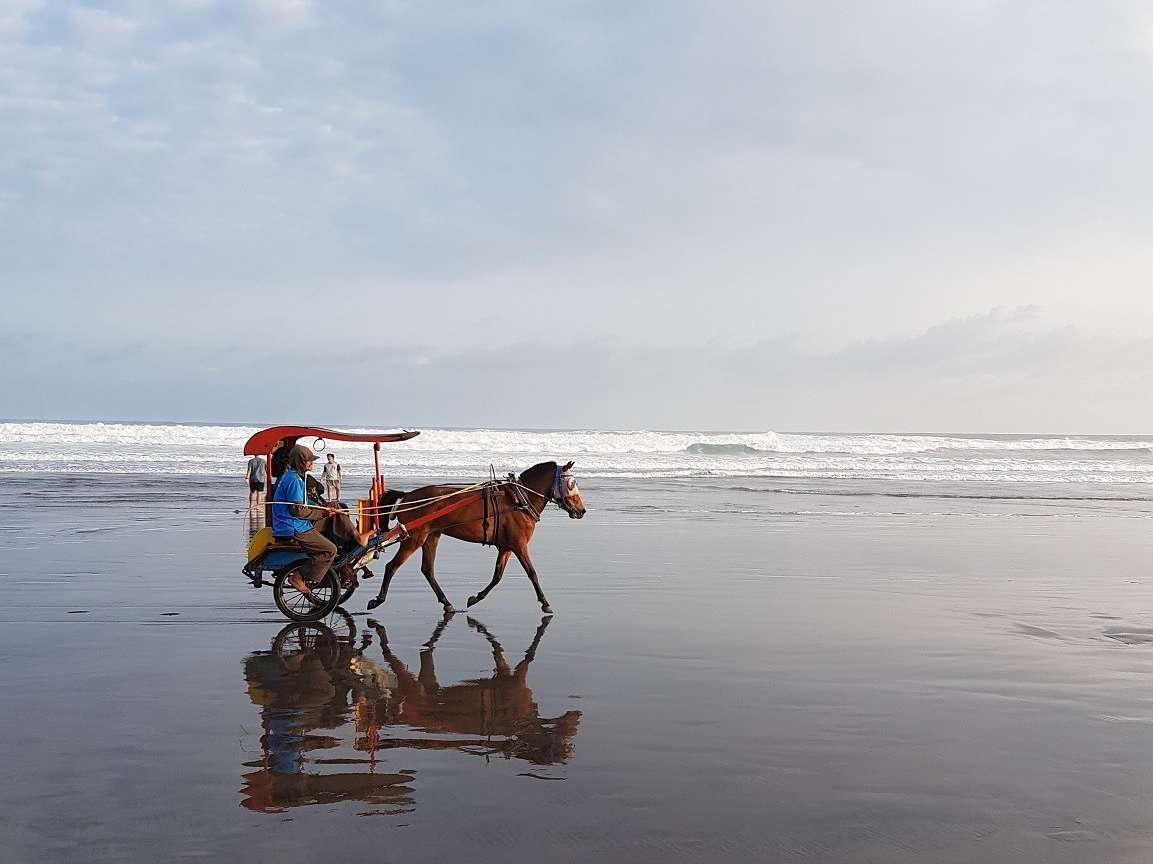
Quite large crowds of mainly local tourists visit Parangtritis over weekends and at holidays. Larger tourist buses as well as various types of cheaper minibuses ply the route to the beach from Yogyakarta. There are local tourist facilities at Parangtritis including parking arrangements, modest hotels which provide visitors with places to change and shower, and small restaurants. Often small ponies or horse-drawn carts can be hired for rides along the beach. Tourists also visit some of the various caves and springs in the cliffs and hills near Parangtritis, such as the Tapan cave and the Beji spring, which are quite close to the beach. Parangtritis is sometimes said to be a place to meet the legendary Nyai Loro Kidul (also known as Ratu Kidul) or 'Queen of the South'. Local folklore warns visitors not to wear green clothes or the queen is likely to try to entice the wearer into the ocean to drown. The beach is not really a good swimming beach. Drownings are not uncommon at Parangtritis, partly because many Indonesians have never had the opportunity to learn proper swimming techniques at beach and partly because channels, strong rips and sizable waves often occur off the beach.

UNESCO defines three main learning settings. Formal education takes place in education and training institutions, is usually structured by curricular aims and objectives, and learning is typically guided by a teacher. In most regions, formal education is compulsory up to a certain age and commonly divided into educational stages such as kindergarten, primary school, and secondary school. Nonformal learning occurs as an addition or alternative to formal education. It may be structured according to educational arrangements, but in a more flexible manner, and usually takes place in community-based, workplace-based or civil society-based settings. Lastly, informal settings occur in daily life, in the family, any experience that has a formative effect on the way one thinks, feels, or acts may be considered educational, whether unintentional or intentional. In practice, there is a continuum from the highly formalized to the highly informalized, and informal learning can occur in all three settings. For instance, homeschooling can be classified as nonformal or informal, depending upon the structure.
Regardless of setting, educational methods include teaching, training, storytelling, discussion, and directed research. The methodology of teaching is called pedagogy. Education is supported by a variety of different philosophies, theories and empirical research agendas.
There are movements for education reforms, such as for improving quality and efficiency of education towards relevance in students' lives and efficient problem solving in modern or future society at large, or for evidence-based education methodologies. A right to education has been recognized by some governments and the United Nations.Global initiatives aim at achieving the Sustainable Development Goal 4, which promotes quality education for all.

 TOURISM is the act and process of spending time away from home in pursuit of recreation, relaxation, and pleasure, while making use of the commercial provision of services. As such, tourism is a product of modern social arrangements, beginning in western Europe in the 17th century, although it has antecedents in Classical antiquity.
Hello This is Wildatul Aluf Blog hope you enjoy it...... I Learn Internet Blogging in STIBA-IEC Jakarta Blogging is my new hobby now h...


